Ayala Land identifies and manages economic, environmental and social issues and topics that are material to its stakeholders and core businesses, aligned with the UN Sustainable Development Goals (SDGs), the six capitals of the Integrated Reporting <IR> Framework, Global Reporting Initiative (GRI) Indicators, Sustainability Accounting Standards Board (SASB) Material Topics, and Task Force on Climate-Related Financial Disclosures (TCFD) Recommendations.
Building on the comprehensive Double Materiality Assessment we conducted in 2024, we continue to refine our strategic priorities to address the most impactful ESG risks and opportunities. This assessment serves as a critical foundation for the future, ensuring that our resources are directed toward the topics that drive long-term resilience and value for our stakeholders.
These insights guided the refinement of our ESG strategy and Sustainability Focus Areas, ensuring that our programs directly address the issues most material to our stakeholders and the most urgent challenges shaping the Philippine real estate sector
ALI conducts thorough technical due diligence for geohazards and climate risks. Through the development of comprehensive adaptation and mitigation strategies, ALI strengthens emergency preparedness, disaster response mechanisms, and resilient operations through business continuity plans in the face of evolving environmental challenges.
ALI is committed to transitioning its properties and fleet to renewable energy, while enhancing carbon forest projects and maintaining the permanent carbon sink. We are on track to achieving our Net Zero 2050 ambition through the implementation of innovative solutions, prioritizing low carbon development and establishing robust policies to green the supply chain.
Materials, energy, and water management programs drive resource efficiency and conservation across all operations. ALI reduces its dependency on potable water and prioritize water reuse. Waste management practices also align with a circular economy model for waste management that reduces waste send to landfill.
Ayala Land develops projects that integrate pedestrian mobility and transit connectivity, ensuring people can move safely and efficiently. Through open and green spaces landscaped with native species, we promote biodiversity while offering inclusive environments that enhance well-being and safety for our communities.
ALI prioritizes local hiring to support communities and create inclusive opportunities for local enterprises to participate in our value chain, fostering innovation, resilience, and shared prosperity across the communities where we operate. By investing in human capital through training and education, we empower individuals with the skills needed for long-term growth. By choosing local supply sourcing, ALI ensures that operations contribute to sustainable development with a reduced environmental impact.
To measure Ayala Land’s performance and report its impact on local and global development, Ayala Land identified UN SDGs and GRI, SASB and TCFD topics that correspond to the four focus areas and other material topics.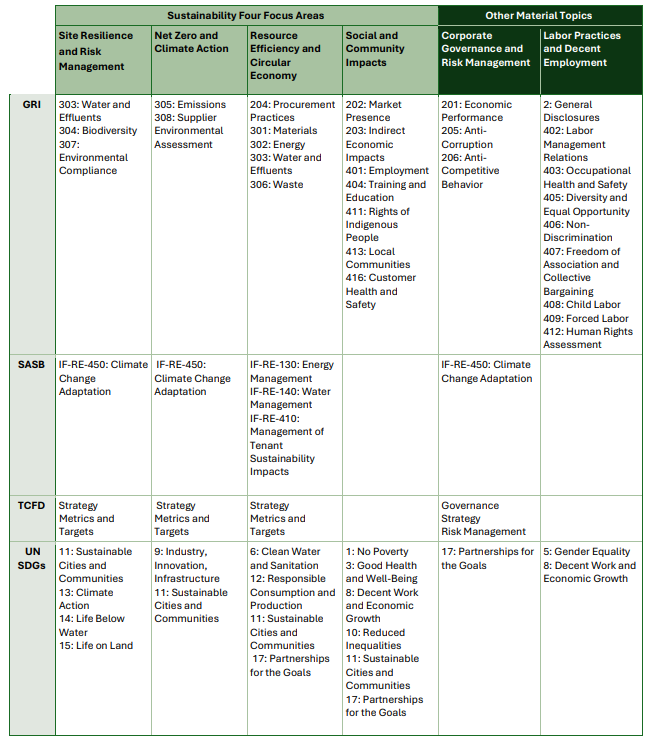
Ayala Land is committed enhancing its ability to quantify and assess the impacts of its operations on society, business, and the environment. The conduct of a comprehensive Materiality Review will shape the framework of our sustainability strategy, guiding the development of policies and projects aimed at mitigating the negative impacts and enhancing the positive impacts. Furthermore, future company disclosures will be aligned with International Financial Reporting Standards (IFRS) requirements, specifically for sustainability-related financial information (S1) and climate-related disclosures (S2) for the succeeding reporting periods.
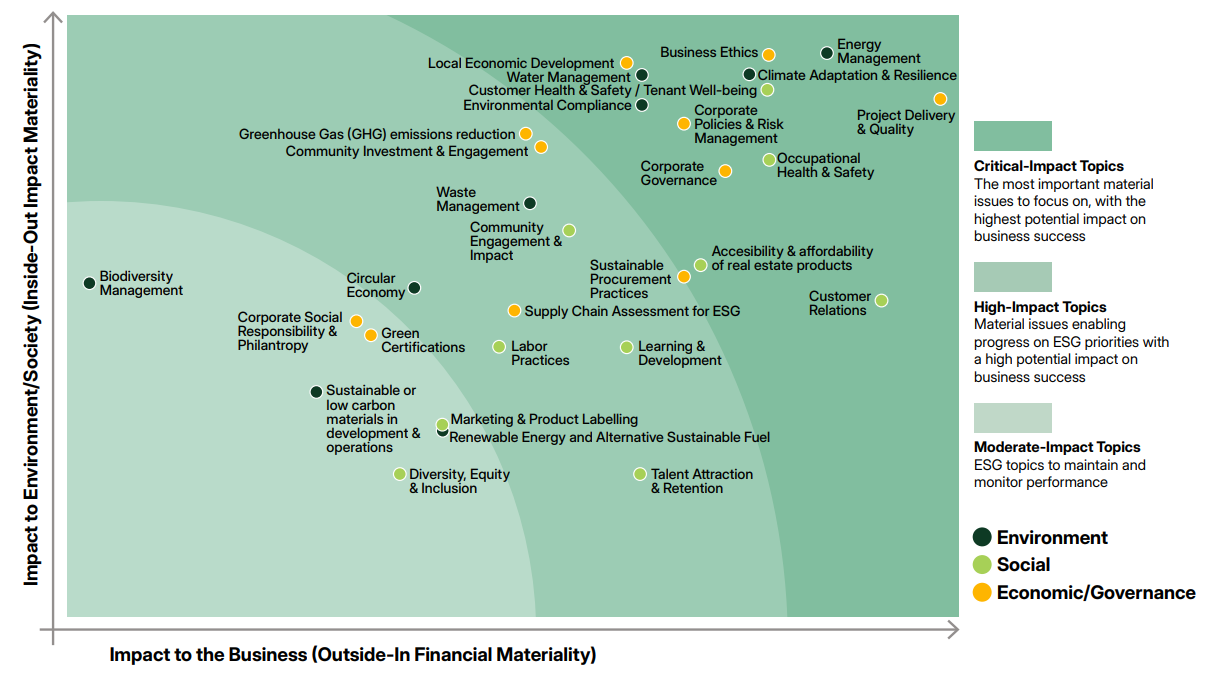
Ayala Land conducts an annual review its material topics through discussions with stakeholders and core businesses. Adhering to the materiality assessment practices of the IIRC, GRI, and SASB reporting standards,, thirty (30) material topics were considered for review. These were derived based on the company’s current ESG approach and focus areas, through a peer benchmarking analysis, and by reviewing existing and upcoming regulatory standards and frameworks.
Under a double materiality approach, Ayala Land’s ESG topics were assessed by the company’s impacts to the environment and society and by the impact of the external environment on the company’s financial performance how we create value.
Representatives from a range of relevant stakeholder groups were invited to provide feedback on the identified material topics to obtain a perspective on the relative importance of the company’s material issues as it impacts our stakeholders and our business.
Results from the double materiality assessment plotted the 30 material topics into three distinct categories on an impact matrix.